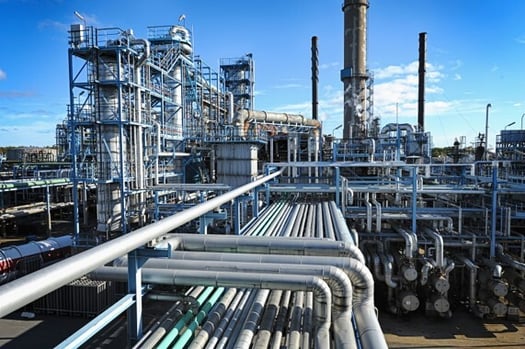
From upstream production to downstream refining and chemical manufacturing, our advanced suites of process and flow simulation software let engineers design and operate efficient plants, resolve bottlenecks, and eliminate hazards associated with transient events. Built on decades of industry expertise, Datacor solutions optimize system costs and cut carbon intensity.
Non-Newtonian well-head fluid injectionsOff-shore & on-shore fire water system designPrevent choke & waterhammer in hydrocarbon linesFlow assurance (slugging, hydrates)Compressor surge analysis
Case studies
Safety of Offshore Oil Rig Sea Water Injection System — Hatch (Datacor Impulse)
A HAZOP review on a North Sea production facility identified no prior surge analysis on the water injection system spanning five platforms. Impulse confirmed that valve closure at current and design flow conditions would not exceed piping design pressure across any scenario.
Surge Pressures and Forces Reduced on Offshore Oil Platform — Wood (Datacor Impulse)
Wood performed a hydraulic transient analysis on a Gulf of Mexico platform exporting 140,000 BOE/day to a subsea pipeline. Recommendations reduced pressure pulsations by up to 75%, with transient forces seeing a similar decrease.
A waterhammer analysis on a produced-water injection system off Brazil (FPSO to multiple wellheads, 4–13 km flowlines) revealed peak pressures reaching 312% of design pressure. Minimum safe valve closure times were determined and upstream valve sequencing recommended to mitigate surge.
A transient study on an offshore water injection system (operating above 10,000 psi) revealed that the minimum-flow protection valves opened too late during ESD and valve-failure scenarios. Non-slam check valves and limit-switch logic were implemented to bring forces within acceptable limits.
Gas Processing & Transport — simulation applications
Simulation supports every conditioning and treating step — from acid gas removal and dehydration through NGL recovery — as well as the pipeline and compression systems that move gas to market.
CHEMCAD
Amine sweetening design (H₂S & CO₂ removal)Glycol dehydration column design & optimizationCO₂ removal — membrane & solvent process comparisonNGL extraction & fractionation column sizingMercury removal unit designNitrogen rejection unit simulationDew point control & hydrocarbon recoveryCompressor sizing & interstage cooling designPhase envelope & hydrate formation prediction
Datacor Flow Simulation
Gas gathering & transmission network hydraulicsPumping station and tank farm hydraulicsFire-water system designCompressor station performance & surge analysisLeak detection & line-pack managementSurge & waterhammer (ESD & pump trip scenarios)Amine & glycol unit utility piping hydraulics
Case studies
Crude Oil Booster Pump Waterhammer Field Problem Solved — Beta Machinery Analysis (Datacor Impulse)
Beta Machinery Analysis investigated a valve-slamming and waterhammer problem at a Canadian crude oil booster pump station. Using an iterative boundary-condition approach in Impulse, the model was calibrated to field measurements and used to resolve the client's significant pressure surge problem.
URS used Impulse to evaluate surge mitigation scenarios on a pipeline connecting Colonial's pumping station to a BP tank in New Jersey. Modeling showed that a relief valve alone — replacing a proposed control valve — protected both parties' piping under all worst-case scenarios including power failure.
Access Pipeline's engineer built a logical sub-model in Impulse to replicate real-time control logic for booster pump trip conditions at a crude oil terminal, eliminating the need for intermediate manual runs and enabling accurate assessment of overpressure risk during upset events.
Protton Engineering used Impulse to calculate transient surge forces on a 3 km diesel pipeline in Iraq, reducing the predicted peak force from 208 kN (manual calculation) to just 13.7 kN — a 93% reduction — allowing a much smaller, cost-effective thrust block design.
Feedstock delivery hydraulics to cracker unitsEthylene & propylene distribution networkSteam & cooling water network balancingFire-water system designNon-Newtonian fluids handling
Case studies
Waste Plastic Pyrolytic Oil Upgraded to Fuel-Range Fractions — Warsaw University of Technology (CHEMCAD)
CHEMCAD was used to simulate refinery-type rectification of waste plastic pyrolytic oil across three column configurations. A simplified two-column design successfully produced naphtha, kerosene, and diesel-comparable fractions, and the study showed that blending up to 10% pyrolytic oil with crude oil caused no material change to product yields or fuel properties.
Slurry deposition identified and resolved in polymer cooling system — LyondellBasell (Datacor Fathom)
LyondellBasell used Datacor Fathom's Settling Slurry (SSL) module to model a non-Newtonian polymer slurry cooling loop suffering repeated reliability failures. The model pinpointed deposition zones — later confirmed during a plant turnaround — and targeted piping modifications increased recirculation rate by 15%, cancelled a pump replacement worth $435K, and delivered approximately $247K in annual savings from reduced shutdowns.
From crude distillation to hydrogen balance and blending — simulation spans the full refinery workflow.
CHEMCAD
Crude distillation unit (CDU) & vacuum unitFCC & hydrocracker yield modelingHydrogen balance & hydrotreater designFuel blending optimizationRefinery-wide heat recovery integration
Datacor Flow Simulation
Crude & product piping network hydraulicsFuel gas network balancing across unitsCooling water & steam distribution modelingTankage routing & transfer pump selectionFire-water system design
Case studies
Significant Man-Hours Saved on Refinery Cooling Water Surge Analysis — Fluor (Datacor Fathom & Impulse)
Fluor used Datacor Fathom to design a 40,300 m³/h cooling water system for the Kuwait National Petroleum Company's 454,000 bpd refinery expansion, then seamlessly transferred the model to Impulse for surge analysis. The integrated workflow significantly reduced engineering hours on this lump-sum project.
MegChem modeled a 120 km crude pipeline feeding a South African refinery to design safe MOV closure times following a capacity upgrade. Simulation also uncovered an undersized pressure safety valve — a potentially catastrophic finding — that was corrected before commissioning.
The Case of the Missing HAGO — Crude Unit Tray Damage Diagnosed via Simulation (CHEMCAD)
A calibrated CHEMCAD simulation identified abnormally low tray efficiencies (as low as 35%) in a refinery main column that had lost Heavy Atmospheric Gas Oil yield. The model pointed directly to mechanical tray damage, confirmed by gamma scan, and production was fully restored following a targeted turnaround — avoiding costly trial-and-error operations.
Jet & Diesel Fractionation Optimized Through Column Simulation — Ukraine-Based Research (CHEMCAD)
CHEMCAD was used to rigorously simulate a petroleum distillation unit separating jet and diesel fuel fractions. Sequential Quadratic Programming optimization identified an ideal 24-stage column with a reflux ratio of 0.6 and optimal feed tray location, reducing total energy consumption and providing clear guidance for refinery modernization projects.
600-Pipe Refinery Cooling Water System Recalibrated — Hydrus Works (Datacor Fathom)
Hydrus Works recalibrated a large refinery cooling water system with nearly 600 pipes, 492 junctions, and 127 heat exchangers using over 700 field measurements. The final model achieved flow matches within ±4.8% and pressure within ±1.8 psi, creating an evergreen digital twin for ongoing troubleshooting and capacity planning.
Fuel Blending System Upgraded to Double Ethanol Content — P&I Design (CHEMCAD)
P&I Design used CHEMCAD steady-state and dynamic simulation to assess whether an existing gasoline blending system could increase ethanol content from 5% to 10% across three simultaneous loading arms. The model replicated on-site control failures, identified pressure control limitations, and validated both a short-term workaround and a fully redesigned long-term solution — brought online with minimal disruption.
Site-wide piping network hydraulicsShared steam, H₂ & fuel gas network optimizationTurnaround planning & unit isolation hydraulics
Case studies
Optimization Opportunities Found in Hydrocarbon Separation Process — Sasol (Datacor Fathom)
Sasol modeled an entire integrated hydrocarbon separation plant in Datacor Fathom — 335 pipes spanning storage tanks, liquid-liquid extraction, distillation columns, reboilers, condensers, and control valves. Calibration to live plant data uncovered fouled heat exchangers and identified equipment bottlenecks for future capacity increases.
Firewater System Compliance Verified Across 145-Tank Bulk Fuel Terminal — P&I Design (CHEMCAD)
P&I Design built a CHEMCAD hydraulic model of a 50-acre UK bulk fuel terminal with over 145 storage tanks to verify firewater delivery against Energy Institute IP 19 requirements. The Excel-linked model showed that pump and pipework upgrades alone were insufficient — controlled flow distribution was essential — and the reusable model continues to support operational changes and future investment decisions.
Simulate pressure drop and flow distribution for gas and steam piping systems. Analyze sonic choking and model non-ideal gases under varying operating conditions.
Bring Monte Carlo simulation to decision-making process. Build dynamic models of complex systems to forecast project performance under uncertainty. Use it to evaluate and compare alternative designs, construction sequences, and operational plans.
FERST powered by CHEMCAD makes designing or evaluating existing relief systems simple and more rigorous. Design vapor (tempered), gassy (non‑tempered), hybrid (tempered with gas generation), and non-reactive fire exposure systems (API 520/521, API 2000, OSHA 1910.106, NFPA 30).
Operational Excellence
Purpose-built features for system performance
Surge and waterhammer prevention
Stop waterhammer before it starts
Our transient-flow solver pinpoints pressure spikes in milliseconds, allowing engineers to size dampers, add relief paths, or tweak logic long before a line packs up. By eliminating waterhammer events, you avoid costly downtime, extend pump-seal life, and keep crews safe.
Across upstream, midstream, and downstream operations ensure regulatory compliance by designing fire-water networks which deliver the right pressure and flow at every outlet under worst-case demand.
Improve operational safety and production continuity in gas processing, offshore production, or LNG operation. Minimize flow assurance risks by modeling phase behavior of wellhead fluids — including where hydrates form and where the system crosses into two-phase flow.
Process design, Equipment sizing and heat integration
Design faster, operate smarter
Leverage CHEMCAD's strengths across the chain — amine contactors, glycol dehydrators, distillation columns, heat exchanger networks, compressors. Engineers designing new units or debottlenecking existing ones can size equipment, run pinch analysis, and evaluate feedstock change scenarios in one environment, cutting iteration time significantly.
Evaluate changes in yield, energy consumption, and throughput if you switch feedstock, change operating pressure, or add a recycle stream — without physical trials. Model economic outcomes and run what-if scenarios.