

Chemical
From prediction to production and beyond, see how chemical manufacturers are applying AI to forecasting, formulation, compliance tracking, and operational planning and fulfillment.


AI is transforming process manufacturing — and the leaders pulling ahead aren't just experimenting. They're deploying practical, explainable AI grounded in real operational data.
Datacor partnered with independent research firm Tech-Clarity to survey manufacturers across chemical, food & beverage, engineering, and other process industries — uncovering where AI is delivering real value, where challenges persist, and what the most successful deployments have in common.

Originally aired April 28th, 2026 at 11:00am ET




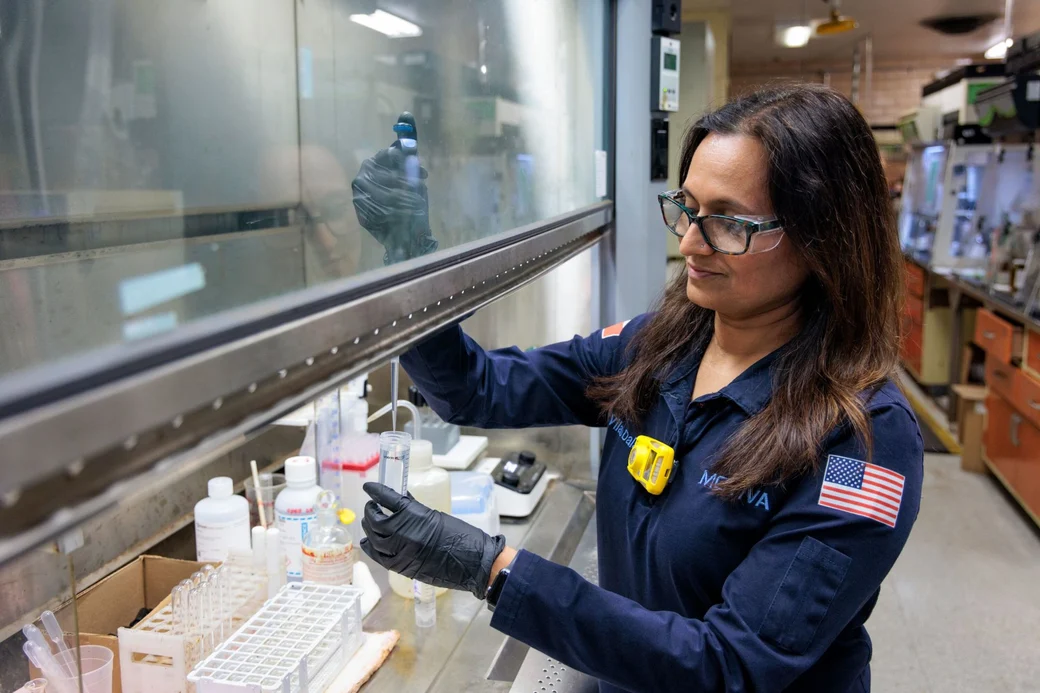




Tech-Clarity spoke with Datacor customers and surveyed over 250 companies to understand how they are approaching AI, where they’re finding success, and what’s holding others back.
What are your primary goals for AI?
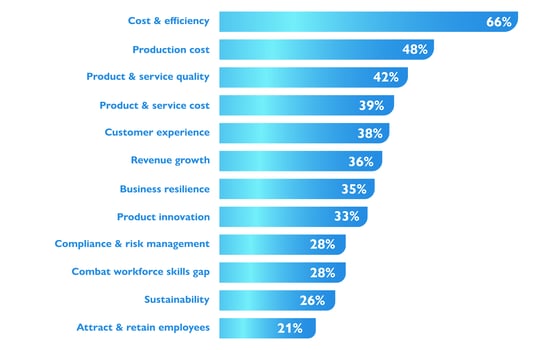
When manufacturers were asked about their primary goals for AI, cost and efficiency came out on top. That tracks: from back-office operations to the production floor, AI offers obvious opportunities to cut waste, reduce manual steps, and speed up workflows. Production cost reduction and product quality improvement follow close behind, pointing to a consistent focus on operational improvement.
But the full picture is more strategic than any single priority.
The range of goals across this data tells a more important story: manufacturers aren't expecting AI to solve just one problem. Revenue growth, business resilience, product innovation, and compliance all register as meaningful priorities. For companies competing on tight margins, efficiency gains aren't just about reducing costs. They also create capacity to reinvest in higher-value work, strengthen the customer experience, and protect the business against disruption.
Cutting costs is the most common AI objective—followed by quality gains and better customer experience.
Which primary functional areas are you targeting for improvement?
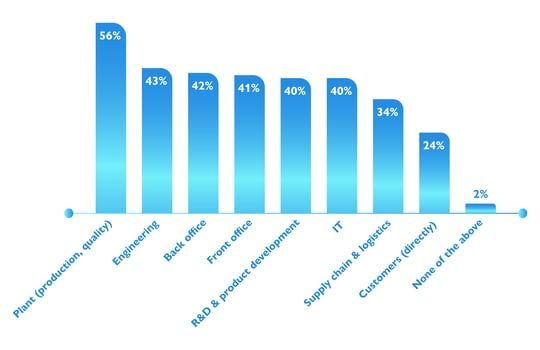
When asked where they are focusing AI efforts, manufacturers pointed to the plant floor first. At 56%, production and quality improvement is the most commonly cited area, reflecting the direct connection between plant performance and business outcomes. But the story doesn't stop there. Engineering, back office, front office, and R&D all show nearly equal levels of focus, signaling that AI is being deployed broadly across the organization rather than in isolated pockets.
What's particularly telling is the breadth of functional coverage.
Even areas that don't directly touch the customer—like accounting, order processing, and product development—are being targeted alongside customer-facing functions. This suggests manufacturers are approaching AI as an enterprise-wide opportunity rather than a departmental experiment.
While plant operations is a clear area for AI Investment, companies are looking for AI to help across the enterprise.
What business improvements looking for AI to help with?
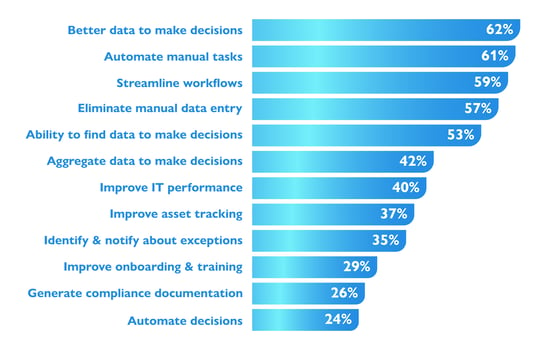
A clear signal from this data is that manufacturers are focused on augmenting human decision-making rather than removing humans from the equation. Better data, automated manual tasks, streamlined workflows, and eliminating data entry all rank at the top—reflecting a practical, near-term desire to free people from repetitive work and put better information in front of them faster.
What's notably lower on the list is just as revealing.
Fully automated, agentic AI—where decisions happen without a human in the loop—sits at the bottom of the priority list. Trust, experience, and process maturity need to develop before manufacturers are ready to hand the wheel entirely to an algorithm.
What organizational challenges are you facing for AI adoption?
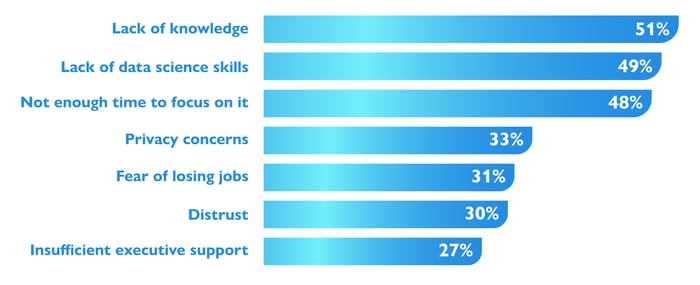
Roughly half of manufacturers cite lack of knowledge, missing data science skills, and not enough time as their top challenges. These are capability gaps, not cultural ones. The message isn't that manufacturers are resistant to AI; it's that they're unsure where to start and don’t have the resources to move forward confidently.
What's notably absent from the top of the list is just as important.
Job loss fears, distrust, and resistance show up far lower than many might expect given the broader public conversation around AI. For solution providers, that's a meaningful signal: the opportunity isn't to convince manufacturers that AI is worth pursuing. It's to help them build the knowledge, skills, and infrastructure to actually do it.
The biggest barriers to AI adoption are practical ones. The industries we serve are ready to move; they need the right support to get there.

Access the full research suite, benchmark statistics, and expert analysis to understand how manufacturers are turning operational data into measurable AI outcomes. The reports will be available early May.
From prediction to production and beyond, see how chemical manufacturers are applying AI to forecasting, formulation, compliance tracking, and operational planning and fulfillment.

Learn where engineers are using AI to improve decision making, engineering processes, and outcomes.


Explore how food, beverage, and animal nutrition companies are using AI to strengthen supply chains, protect margins, improve demand planning, and maintain regulatory compliance.

/Screenshot%202026-10-15%20at%208.42.17%20PM.png?width=300&height=170&name=Screenshot%202026-10-15%20at%208.42.17%20PM.png)


-2.png?width=300&height=170&name=Blog%20Feature%20Image%20(1)-2.png)

Datacor focuses on building AI into its products to directly improve operational workflows — not simply providing theoretical models. By grounding AI capabilities in structured manufacturing data and real production processes, organizations can deploy solutions that are auditable, scalable, and immediately actionable.