
Compressed gas cylinders are the backbone of your business and one of your biggest risks.
Every day, cylinders move through filling plants, depots, trucks, and customer sites. Along the way, they sit in storage areas, laydown areas, and “temporary” corners that slowly become permanent. If storage is sloppy, you are exposed on three fronts at once: safety, compliance, and rental revenue.
Many distributors do a good job on the basics, but still rely on a mix of tribal knowledge, spreadsheets, and occasional audits to keep things under control. That might feel “good enough” until an incident, inspection, or major write-off forces you to take a harder look.
In this article, we will walk through the key themes behind compressed gas cylinder storage, explain how regulations like OSHA and NFPA shape what you do on the ground, and look at practical ways to tighten up storage while improving visibility of your cylinder fleet.
Disclaimer: This article is for general information only. It is not legal or regulatory advice. You should always review the full OSHA, NFPA, CGA, and local code requirements that apply to your facilities and work closely with your safety or compliance team.
Why Cylinder Storage Matters More Than You Think
Poor storage is not just a housekeeping problem. It has real consequences.
Safety comes first
Cylinders contain gases under high pressure. If they are knocked over, overheated, or damaged, you risk leaks, fires, and serious injury. A single cylinder falling and snapping a valve can cause a chain reaction in a cramped storage area.
Compliance is always in the background
You are operating under a mix of OSHA standards, CGA guidance, NFPA codes, and local fire and building requirements. Inspectors will look at how cylinders are stored, separated, labeled, and protected. If storage areas are clearly not under control, it will get noticed.
Revenue quietly leaks away
Storage is also where cylinders disappear. Full and empty cylinders get mixed together. Idle assets sit in corners for months. Paper logs and whiteboards drift out of date. Over time, that turns into lost cylinders, unbilled rentals, and extra purchases to cover shortages.
When you treat storage as part of asset management, not just safety, you start to see how much it touches margin, customer service, and working capital.
The Rules: What OSHA, NFPA, and Others Expect
You do not need to memorize every line of every standard, but you do need a clear picture of the main players and how they affect storage.
OSHA and CGA
 OSHA’s general requirements for compressed gases point employers to Compressed Gas Association (CGA) guidance for safe handling and storage. In practice, that means OSHA expects you to:
- Store cylinders so they are unlikely to be damaged or knocked over
- Protect valves and valve caps
- Keep containers in safe condition based on inspection and testing
- Follow CGA pamphlets, such as CGA P-1: Standard for Safe Handling of Compressed Gases in Containers, which OSHA incorporates by reference for in-plant handling and storage.
OSHA 29 CFR 1910.253 then goes deeper on oxygen–fuel gas systems used for welding and cutting. For example, 1910.253(b)(2) addresses storage. Cylinders must be kept in a dry, well-ventilated, clearly defined area that is secure, protected from passing or falling objects, and not subject to unauthorized tampering. They must be stored at least 20 feet (6.1 meters) from combustible liquids or solids or separated by an approved fire-resistive barrier. Lockers and cupboards are not considered suitable storage locations.
NFPA and local fire codes
NFPA 55, the Compressed Gases and Cryogenic Fluids Code, and related NFPA standards focus on the fire and life safety aspects of compressed gases. They deal with topics like:
- Where and how cylinders can be stored
- Separation distances from buildings, property lines, and openings
- Ventilation and exhaust expectations
- Fire protection features around storage areas
For welding and cutting, NFPA 51, Standard for the Design and Installation of Oxygen–Fuel Gas Systems for Welding, Cutting, and Allied Processes, states that oxygen cylinders must either be stored at least 20 feet from fuel-gas cylinders or be separated by a suitable fire-resistive partition:
NFPA 1, the Fire Code, and its Uniform Fire Code editions add further detail on cylinder use and storage, including expectations for sprinkler protection and exhaust in certain enclosures. Those requirements are often adopted into state or local fire codes.
ICC and specialized cylinders
The International Code Council (ICC) model codes also address compressed gas systems, especially newer two-wall gas cylinders and flammable cryogenic liquids. For example, rules around vacuum-jacketed cylinders specify how the vacuum jacket and outer cylinder must be constructed and tested, including designs that can withstand pressure differentials (such as a 30-psi differential on the jacket). These technical details matter most for your engineering and safety teams, but they reinforce a simple point: specialized cylinders come with specialized storage and protection requirements.
Your authority having jurisdiction
Every facility ultimately answers to an authority having jurisdiction (AHJ). This might be a fire marshal, building department, or other local official. They will interpret and enforce the standards that apply in your area.
The reality is simple: you are responsible for understanding which codes and standards are in force for your plant, filling operation, or depot, and for making sure your storage practices match them.
Again, this is only an overview. For specific obligations, you must go back to the actual standards and work alongside your safety or compliance experts.
Practical Habits for Safer, More Compliant Storage
Regulations can be dense, but the underlying themes are straightforward:
- Can cylinders be knocked over, overheated, or struck?
- Are incompatible gases and combustibles properly separated?
- Can people clearly see what is stored where?
- Is the space reasonably safe if there is a leak, fire, or other event?
Here are some practices that align with common regulatory expectations. Your own procedures should always be based on the specific codes and guidance that apply to your locations.
Keep cylinders upright and secure
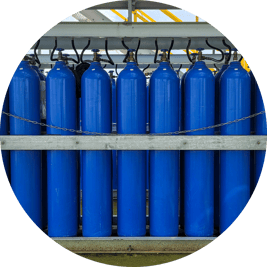
As a rule, compressed gas cylinders should be kept in a vertical position and secured so they cannot fall. In many facilities that means:
- Chains or straps around cylinders in racks or against walls
- Proper cylinder pallets or cradles
- Storage areas designed to prevent cylinders from tipping or being struck
Some guidance allows certain small containers (for example, cylinders around 5 liters / 1.3 gallons or less) to be used in a horizontal position, but that is the exception, not the norm. In practice, most distributors treat “upright and secured” as the default for storage and use.
Where cylinders could be exposed to heat, codes also expect appropriate pressure-relief devices so that if a cylinder becomes overheated and over-pressurized, it can relieve pressure in a controlled way rather than failing violently.
Avoid areas where cylinders can be hit by forklifts or vehicles or where they block exits and escape routes.
Protect valves and handle cylinders with care
Valves and valve protection caps are critical safeguards. Typical requirements and best practices include:
- Fit valve protection caps whenever cylinders are not connected or in use
- Hoist cylinders with proper mechanical means, not magnets or improvised choker slings
- Roll cylinders on their bottom edges when necessary, never on their sides, and never drag them by the cap
- Do not drop cylinders, strike them, or allow them to collide violently
- Never use valve protection caps as lifting points
In use, cylinders should stay upright and stabilized with a cylinder truck, chain, or other steadying device. When a cylinder is emptied, its valve should be closed fully and the cap refitted until it is returned.
These are simple behaviors, but they dramatically reduce the chance of a major incident in storage or staging areas.
Separate incompatible gases and combustibles
Fire and explosion risk drive many of the separation rules. In practice, you should be thinking about:
- Keeping flammable gases away from oxidizers
- Keeping cylinders clear of oil, grease, paper, and other combustibles
- Avoiding storage near open flames, sources of heat, and electrical hazards
Your specific separation distances and barrier requirements should come from the codes and standards adopted by your AHJ.
Provide ventilation and protection
Cylinders should not be stored in dead air, cramped corners with no way for gas to escape. Good practice includes:
- Use well-ventilated storage locations
- Work with your fire protection engineer and AHJ on whether mechanical exhaust, detection, or sprinklers are required
- Avoid low-lying, confined, or hard-to-reach areas for large cylinder groups
NFPA and uniform fire codes often expect sprinkler protection and exhaust ventilation for certain indoor storage configurations. Local enforcement and design details vary, but the goal is consistent: if a leak or fire occurs, the space should give occupants a fighting chance to respond and exit safely.
Label contents and status clearly
A storage area full of unlabeled cylinders is a problem waiting to happen. Make it easy for your team to see:
- What gas is in each cylinder
- The hazard class of that gas
- Whether each cylinder is full, in service, or empty
Many distributors use colored tags or simple boards to indicate status. The key is to keep it consistent across locations and make sure everyone understands the system.
Common Storage Pitfalls We See in the Field
When we talk to compressed gas distributors, certain patterns show up again and again. They look minor on a normal day, but they undermine both compliance and profitability over time.
 “Temporary” areas that never go away
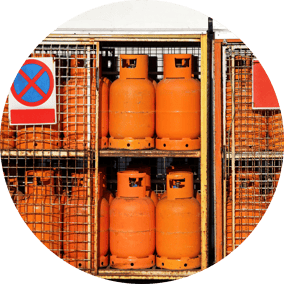
A corner near the dock, a row by the fence, a spare bay in the warehouse. These spaces are used for short-term staging and then quietly become permanent storage without the right restraints, signage, or separation. Over time, they get messy and hard to defend in an inspection.
Full and empty cylinders mixed together
It is not unusual to see full and empty cylinders stacked side by side. Staff spend time sorting them manually. Empties get missed or buried. Rental charges fall through the cracks because no one can see which cylinders are actually earning money.
Mixed gas types in the same storage area
You walk into a storage area and see flammable, oxidizing, and inert gases all sharing the same space with no clear structure. Someone might know what is going on, but an inspector will see confusion and risk.
Paper, spreadsheets, and whiteboards running the show
Manifests, test dates, and storage notes live on clipboards, in spreadsheets on a shared drive, or on a whiteboard near the area. They are out of date as soon as cylinders move between locations. No one has a reliable, up-to-date view.
None of these are unusual. They are simply the byproducts of a busy operation trying to keep up. The question is what you do about them.
Making Storage Easier with Better Asset Visibility
You cannot fix what you cannot see. That is where digital asset tracking changes the equation.
TrackAbout is a specialized asset tracking system built for compressed gas distributors. It is designed to help you answer three basic questions at any time:
- What cylinders do we own?
- Where are they?
- Are they earning money or creating risk?
Here is how it relates directly to storage.
See what is stored where
With barcodes or RFID tags and standardized scanning at key points, you get a live picture of which cylinders are in each storage area, yard, or room, and which are out at customer sites. It becomes much easier to enforce separation, spot overcrowded areas, and keep storage layouts under control.
Support your compliance story with data
Every scan adds to the history of a cylinder: where it was filled, when it was delivered, when it returned, where it is stored now. You can also record inspections and test dates. When something goes wrong, you are not relying on memory or old paperwork to reconstruct the story.
Protect rental revenue and reduce loss
Storage is where cylinders often disappear. With better visibility, you can see which cylinders are sitting idle, which customers are holding on to assets too long, and where stock is piling up. That helps you recover assets, improve turns, and avoid unnecessary purchases. Learn how better asset visibility with TrackAbout increased Guljag Industries' productivity.
Keep branches aligned
Once you have the same tracking process in every branch, storage stops being a series of local workarounds. Everyone uses the same methods, the same labels, and the same data. That makes it far easier to maintain good storage habits over time.
What You Can Do Next
If you are looking at your cylinder storage and thinking “we could be tighter,” you are not alone. Most distributors feel the same way.
Here is a simple way to move forward:
- Walk your storage areas with fresh eyes
Visit your storage or laydown areas and depots with your safety or compliance lead. Compare what you see to your current procedures and to the standards that apply. Capture photos and notes. - List the information you wish you had
As you walk, ask yourself: do we know exactly what is in this storage area? How long has it been here? Which of these cylinders are generating rental revenue and which are just taking up space? - Explore how others are using technology to help
Talk to distributors who have already moved from paper and spreadsheets to a dedicated asset tracking system. Understand how they connect storage, logistics, and billing.
If you would like to see how TrackAbout can help you keep cylinder storage safer, more compliant, and more profitable, our team can walk you through real examples from compressed gas suppliers like you and tailor a demo to your operation.
The goal is simple: storage areas that are safe and compliant, and a cylinder fleet you can see, control, and trust.