
Refineries, pipelines, and petrochemical facilities have invested heavily in online analyzers. NIR, NMR, GC instruments run around the clock, generating predictions on product quality every few minutes. For process engineers and control room operators, that sounds like a data advantage. In practice, most facilities are only capturing a fraction of the value those analyzers can deliver.
Most facilities manage the data with a patchwork of spreadsheets, shared drives, and manual copy-paste workflows. This creates a dangerous gap between real-time predictions and validated primary lab results.
The problem is not the analyzers. The problem is that analyzer predictions and primary lab results live in separate systems, and reconciling them correctly, at scale, and with every timestamp matched has always been a manual job.
The Real Challenge: Matching Every Lab Point to Its Analyzer Prediction
Ask any chemometrician or process engineer what the hardest part of managing online analyzer performance is, and they will give you the same answer: getting the data lined up correctly.
To evaluate how well an online analyzer is performing, you need to compare each lab primary method result to exactly the right analyzer prediction — the one taken at the closest corresponding time on the same stream. That sounds simple. It is not. Analyzer predictions come in continuously, sometimes one sample every seven minutes. Lab samples come in on a scheduled basis, sometimes hours apart. The timestamps rarely align cleanly. Stream tags, sample IDs, and lab identifiers live in different systems. Spectra files are stored separately, often on shared drives with inconsistent naming conventions.
The result is that building a proper analyzer performance dataset — the kind you need to develop or update a chemometric model — requires someone to manually pull prediction data, locate the matching lab results, reconcile timestamps, clean the data, and format it for the modeling software. Depending on how many parameters a facility is managing, that process can consume 20 to 40 hours of engineering time per parameter, per model update cycle.
That time is not going toward analysis. It is going toward data assembly.
What OASIS Does Differently
OASIS is a web-based online analyzer management system built specifically to solve the data management problems that refineries, pipelines, and petrochemical facilities face when trying to extract value from their online analyzer infrastructure.
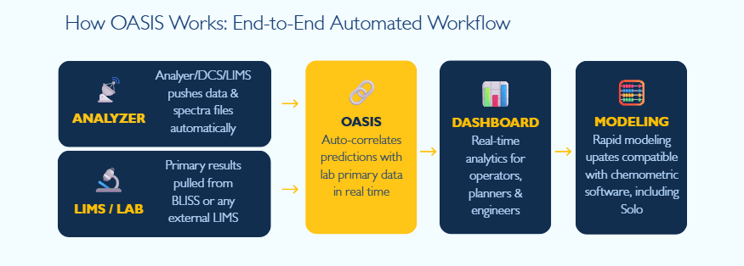
The core function of OASIS is automatic correlation. The system captures online analyzer predictions and associated spectra files as they are generated, then automatically matches those predictions to the appropriate laboratory primary method results. That correlation is stored in the OASIS database, where it is available for analytics, reporting, and chemometric model development at any time.
This matters for two reasons.
First, it means the data is always current. There is no backlog of unreconciled predictions waiting for someone to process them. When a lab result comes in, OASIS already knows which analyzer prediction corresponds to it.
Second, it means that generating a chemometric modeling data packet — the structured dataset a process engineer sends to Eigenvector Solo or another chemometric platform to build or update a model — is no longer a manual process.
In OASIS, it is a single button click. The system assembles the matched prediction and primary data set, formats it correctly, and makes it available for download. What previously required tens of hours of busy work becomes a task that takes minutes.
| ⚠️Today's Reality: The Status Quo |
✅ OASIS: Automated & Integrated |
|
|
Real-Time Analytics for Control Rooms and Blending Operations
Beyond model development, OASIS provides configurable dashboards that give control room operators and blending engineers a live view of both lab results and analyzer predictions on the same screen, updated in real time.
This is operationally significant. When an analyzer begins to drift — when its predictions start diverging from primary lab results in a consistent direction — the bias shows up immediately in the OASIS dashboard. Operators can see the delta between lab and analyzer values as each new data point comes in, rather than discovering a problem during the next model update cycle or, worse, after a product quality issue has already occurred.
The dashboard is configurable by team function. Blending and planning engineers can view the streams and properties most relevant to their decisions. Control room operators can monitor the analyzers assigned to their units. Lab technicians can see result approval status alongside the corresponding analyzer predictions. Each team gets the view they need without having to navigate through data that is not relevant to their work.
For facilities managing multiple blenders, product streams, and batches simultaneously, the ability to view all of that in one integrated interface — rather than switching between a historian, a LIMS, a spreadsheet, and a shared drive — represents a meaningful change in how quickly and confidently teams can act on what the data is telling them.
Fit for Purpose: Built for Refineries, Not Adapted for Them
We developed OASIS in cooperation with Process Instruments, and that collaboration shows in how the product is scoped. OASIS addresses three specific industry-wide problems that generic data historians and standalone chemometric software tools do not solve well:
- managing online analyzer capability
- reconciling analyzer data with lab primary method data
- generating the structured datasets needed to develop and maintain chemometric models.
The system interfaces with LIMS platforms, process data historians, analyzers directly, and spreadsheets. For facilities running BLISS LIMS platform, the integration is native. For facilities running a third-party LIMS, OASIS provides a standard interface. There is no requirement to replace existing laboratory infrastructure to deploy OASIS.
Model management is also built into the system. OASIS maintains revision control on chemometric models, linking each model version to the specific dataset that was used to create it. That traceability supports internal quality processes and provides an auditable record for compliance and regulatory purposes.
Our 45-year track record in refinery LIMS, statistical quality control, and EPA 1090 compliance reporting underpins the design decisions in OASIS. The product reflects what facilities actually need, not a generalized data management framework adapted for the refining industry after the fact.
 The Bottom Line
Online analyzers only deliver value when the data they generate is accessible, organized, and connected to the primary lab results that validate it. For most facilities, that connection currently depends on manual effort that is slow, error-prone, and difficult to scale.
OASIS automates that connection. It captures predictions, matches them to lab results, and makes the combined dataset available for real-time analytics and one-click model development. The result is better blending decisions, faster model update cycles, earlier detection of analyzer issues, and significantly less time spent on data management tasks that should not require human intervention in the first place.
If your facility runs online analyzers and your team is still assembling model datasets by hand, OASIS is worth a close look.
Contact us to schedule a demo or call (361) 887-8988.