


Every day, crude oil operators make accept/reject decisions, blend calculations, and product release calls based on quality data that lives in email inboxes, PDF attachments, and disconnected spreadsheets. The data exists. The problem is that it cannot be acted on at the speed the business demands. Delayed decisions cost money. Missed blend windows cost margin. And quality data that cannot be queried, trended, or shared in real time is not an asset. It is a liability that compounds with every barrel processed.
The industry is changing fast. Pipelines are moving into blending operations. Crude slates are growing more diverse. And the margin between a profitable batch and a costly rejection is increasingly a function of how quickly and accurately a team can assess the quality of what is coming through the door. The organizations that will win in this environment are not those with the most data - they are those with the best ability to act on it.
The Hidden Cost of Manual Certificate of Analysis Processing
Walk into almost any pipeline terminal or refinery receiving operation today, and you will find the same scene: a quality professional working through an overflowing email inbox, manually opening PDF certificates of analysis (CofAs), cross-referencing specifications in a separate spreadsheet, and making accept or reject decisions by hand. It is a process that has not fundamentally changed in decades, and it carries a cost that rarely appears on any balance sheet.
The risk is not just inefficiency; it is error at scale. Manual data entry is among the most common sources of laboratory non-conformances in oil and gas operations. When a crude batch arrives, and a CofA must be reviewed against product specifications by a person rather than a system, the margin for transcription error, missed flags, and delayed decisions grows with every transaction. In high-throughput environments processing hundreds of shipments per month, that margin becomes significant.
The operational impact is equally concrete. Every hour a terminal or refinery waits for a manual viability determination is an hour of potential demurrage, idle equipment, or delayed transfer scheduling. In a commodity environment where prices fluctuate by the hour, the cost of a slow quality decision is measured in real dollars.
Replacing manual CofA review with automated ingestion and instant specification checking does not just save time — it eliminates an entire category of operational risk.
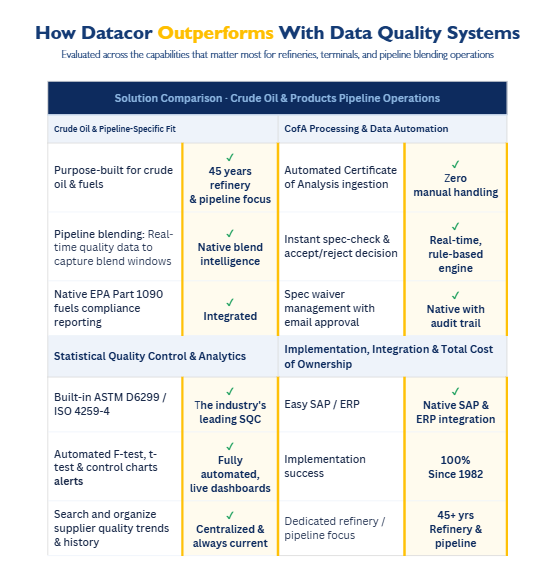
Datacor’s Product Quality Control Solutions automates this end-to-end workflow. Certificates of analysis are ingested directly, checked against current product specifications in real time, and flagged or approved without requiring manual intervention. What previously took hours of inbox management becomes a process measured in minutes.
Fragmented Data Is Not a Storage Problem — It Is a Strategy Problem
Most crude oil and products pipeline operations do not have a data shortage. They have a data organization problem. Quality history exists — in email threads, shared drives, legacy LIMS exports, and analyst memory — but it cannot be queried, trended, or acted upon at speed. When a planner needs to know whether a particular stream has historically met specifications or whether a supplier's quality has been drifting over the past 18 months, the answer requires someone to go digging. By the time the answer arrives, the decision window has often closed—or its entirely unavailable..
This fragmentation has a direct commercial cost. Pipelines that are expanding into blending operations — one of the most significant structural shifts in midstream in the past decade — are fundamentally dependent on access to accurate, real-time quality data across multiple products and crude streams. Identifying a blending opportunity requires knowing the quality profile of available components, their historical variability, and how a proposed blend will perform against finished product specifications. That analysis cannot be done with confidence when the underlying data lives in five different places in five different formats.
The rising need for real-time data analytics in oil and gas has fueled demand for integrated data management systems, as companies increasingly rely on data-driven insights to manage complex operations across diverse sources. What separates leading operators from lagging ones is not the availability of data — it is the infrastructure to centralize, organize, and trend that data so it informs decisions rather than sitting idle.
Data Quality Control Solutions consolidates quality data from every source — instrument feeds, CofAs, lab results, ERP systems, online analyzers, DCS — into a single searchable system of record. Every test, every sample, every supplier can be queried, reported, and trended. Statistical tools can be automated to detect trends and data anomalies. Planners and operators can query historical quality profiles in seconds, identify patterns invisible to manual review, and make blend decisions based on the full weight of available evidence rather than the most recent CofA in an inbox.
From Spreadsheet SQC to Statistical Intelligence: Know When Your Data Is Telling You Something
Statistical Quality Control is not new to the oil and gas industry. ASTM D6299 has provided the framework for applying statistical methods to petroleum testing data to help laboratories and quality managers assess measurement precision and bias. What is new — and still underutilized — is the ability to apply those standards systematically, across every test, in real time, without relying on a lab analyst to maintain a collection of manually updated Excel charts. And to apply similar techniques to sampling points across the entire supply chain or customer shipment.
The gap between SQC in theory and SQC in practice is large at most operations. Spreadsheet-based quality control is brittle. It breaks when analysts leave, when chart templates go out of date, or when the volume of data simply exceeds what a manual system can absorb. It also lacks the diagnostic capability of a purpose-built statistical engine — the ability to automatically apply run rules, violations, run comparative tests such as F-tests and t-tests, and surface out-of-control signals before they propagate downstream into product quality or compliance exposure.
Datacor’s solutions for product quality control replace antiquated and difficult spreadsheets with a fully integrated statistical engine built on ASTM D6299 and ISO 4259-4, but still flexible for each customer’s specific control strategy. Control charts, precision charts, accuracy monitoring, cross-check programs, F-test and t-test automation, and out-of-control alerts are generated automatically in real time. Lab managers gain a real-time view of analytical capability across every instrument and every test and rather than a snapshot from last quarter's manual update, it is now a continuous current picture of whether the measurement process itself is in control. That intelligence is the foundation on which every other quality decision rests.
Turning Quality Data into a Commercial Advantage
The organizations that will define best practice data quality over the next five years will not be those that invested in better spreadsheets. They will be those who made the transition from reactive quality documentation to proactive quality intelligence, where quality data is not a record of what happened, but a real-time input into what to do next.
Datacor’s solutions for product quality control are powered by 45 years of crude oil and product testing LIMS expertise. With a smooth implementation process that quickly leads to an ROI, is purpose-built for that transition.
From automated CofA processing and instant viability decisions, to centralized quality history, integrated statistical control, and real-time blending intelligence, the platform addresses the full spectrum of challenges facing midstream operators today.
The competitive advantage in this industry increasingly belongs to teams that can answer critical quality questions and act on those answers before the window closes.
Contact Datacor to request a personal demonstration and see how Datacor Quality Control Solutions can transform your product quality data into your most valuable operational asset.