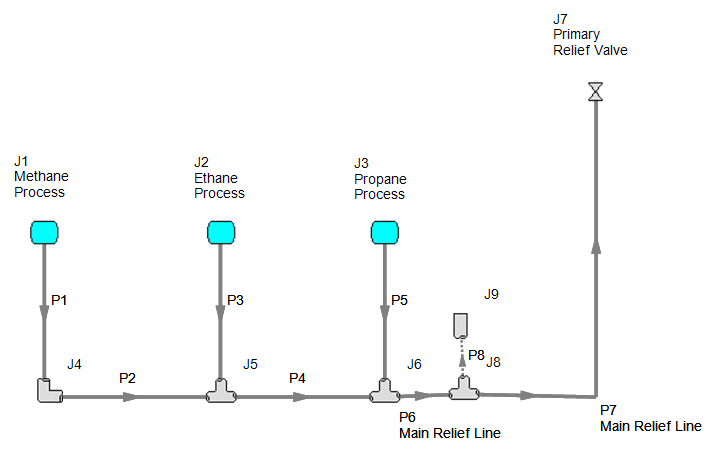

Learn how to use Datacor Fathom (formerly AFT Fathom) and Datacor Arrow (formerly AFT Arrow) to help calculate the Likelihood of Failure (LOF) for Flow Induced Vibration (FIV), Acoustic Induced Vibration (AIV), and Flow Induced Pulsation (FIP) in accordance with Energy Institute Guidelines to avoid vibration induced fatigue failure.
Introduction to Vibration Induced Fatigue and Failure
Repeated vibration on a piping system can result in vibration induced fatigue and failure. Pipe failure due to vibration creates safety concerns for personnel and environmental contamination, as well as costly downtime and repairs. Despite these concerns, vibration sources and resulting fatigue are often not addressed by design standards. Instead, designers and operators often react to vibration issues rather than prevent and avoid these issues proactively.
In response to vibration concerns, the Energy Institute developed the guidelines for the avoidance of vibration induced fatigue failure in process pipework. These guidelines provide many sources of vibration for engineers to consider, many of which can be identified or modeled in an Datacor Flow Simulation (formerly AFT) application as found in Table 1.
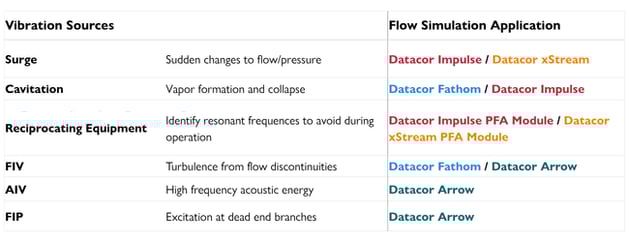
Table 1: Various vibration and pulsation sources and their relevant Datacor Flow Simulation application for modeling
These guidelines provide a structured approach to identify, assess, and correct vibration concerns through qualitative and quantitative methods. Datacor has developed a spreadsheet which, in conjunction with model output and user input, can perform the recommended quantitative assessment of different vibration sources. These calculations used with the Energy Institute guidelines will help engineers identify vibration concerns in their systems.
This blog focuses on the cause and concerns of Flow Induced Vibration/Flow Induced Turbulence (FIV), Acoustic Induced Vibration/High Frequency Acoustic Excitation (AIV), and Flow Induced Pulsation/Periodic Flow Induced Excitation (FIP).
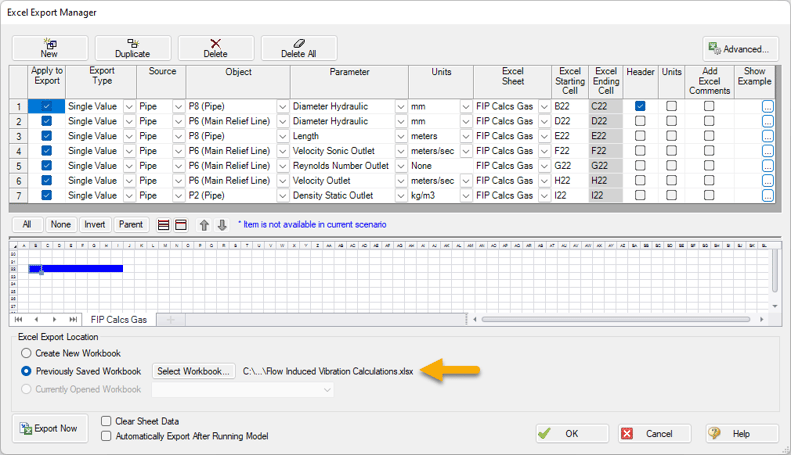
This blog explains what is required to assess each type of vibration, and references how to use Datacor Flow Simulation's vibration assessment spreadsheet with included instructions, the Excel Export Manager, and user input to determine the likelihood of failure (LOF) for a particular vibration concern.
Flow Induced Vibration / Flow Induced Turbulence (FIV)
"Flow induced vibration (FIV)" or "flow induced turbulence" describes the potential for vibration due to the turbulence of flow through a piping system. This vibration can occur in both liquid systems (modeled in Datacor Fathom) and gaseous systems (modeled in Datacor Arrow). This turbulence is especially concerning near discontinuities in flow, such as tees, equipment, partially closed valves, reducers, etc. In general, a more turbulent system (indicated by large Reynolds number) has a higher likelihood of vibration.
Turbulence inputs a wide band of energy, but the largest excitation occurs at low frequencies (< 100 hz). The vibration response at these low frequencies is often visible, either moving the pipe itself or its supports.
Determining the likelihood of failure
There are several factors that inform the likelihood of failure (LOF) due to flow induced vibration. These factors have been split into results exported from Datacor Fathom or Datacor Arrow and required user input. The export process is explained in detail in the linked instructions document.
Exported from a Datacor Fathom or Datacor Arrow model
- Fluid Density (ρ)
- Fluid Velocity (v)
- Pipe Internal Diameter (D,int)
- Gas Dynamic Viscosity* (µ) – Only required for gas systems
User Input
- Span Length (L,span) – The maximum length between supports
- Wall Thickness (T) – Used to determine external diameter
- Structural Natural Frequencies (fn) – Advanced only
Based on these inputs, the spreadsheet will calculate a representation of kinetic energy, a fluid viscosity factor (only for gases), the stiffness of the support arrangement, a 'Flow Induced Vibration Factor', and finally the likelihood of failure (LOF). The calculated LOF should be used with the Energy Institute guidelines to determine the appropriate corrective actions, if necessary.
Acoustic Induced Vibration / High Frequency Acoustic Excitation (AIV)
Determining the likelihood of failure
- Upstream pressure of device (P1)
- Downstream pressure of device (P2)
- Upstream temperature of device (Te)
- Mass flowrate (W)
- Low noise trim component
- Molecular weight (MW)
- Main line internal diameter (D,int)
- Branch external diameter (d,ext)
- Distance from source to discontinuity (L,dis)
- Whether piping material is duplex
- Wall thickness of main line (T)
- Whether discontinuity is a weldolet fitting
Flow Induced Pulsation / Periodic Flow Induced Excitation (FIP)
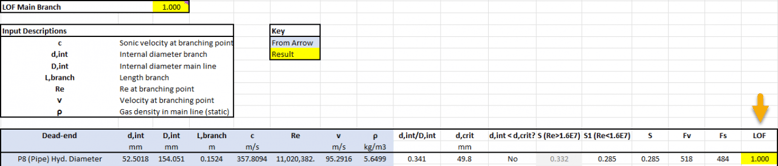
Determining the likelihood of failure
- Sonic velocity at branch point (c)
- Branch internal diameter (d,int)
- Main line internal diameter (D,int)
- Length of branch (L,branch)
- Reynolds number at branch (Re)
- Velocity at branch (v)
- Static gas density in main line (ρ)
Workflow Example: Flow Induced Pulsation