


AI in distribution is being sought after as a fix for visibility, forecasting, and optimization. For most operations still tracking assets in spreadsheets, it will be none of those things.
Operational teams can get surprisingly far with manual asset tracking because people will find a way to fill the gaps as they go. Then things start to change. People get busier, spreadsheets miss updates, disconnected systems start to disagree with each other, profit margins shrink. To fix it, teams are eagerly rolling out AI solutions. The problem is that asset data full of gaps and inconsistencies feeds the AI system knowledge base. Instead of scaling for growth, AI scales those errors right back into every output. To get ahead of this, before AI can deliver value in distribution, asset data has to be clean, timely, and connected across all systems.
Why this matters now
AI pilots in operations with returnable assets may not fail during the pilot. Pilots get curated. Test environments get scoped, data gets touched up, edge cases set aside for later, timelines rushed. Following implementation, over time, the cracks start to show and the team isn’t as productive as expected. As reported in MIT Sloan, 70-80% of successful AI pilots never reach production deployment. The pilot worked. The rollout didn't.
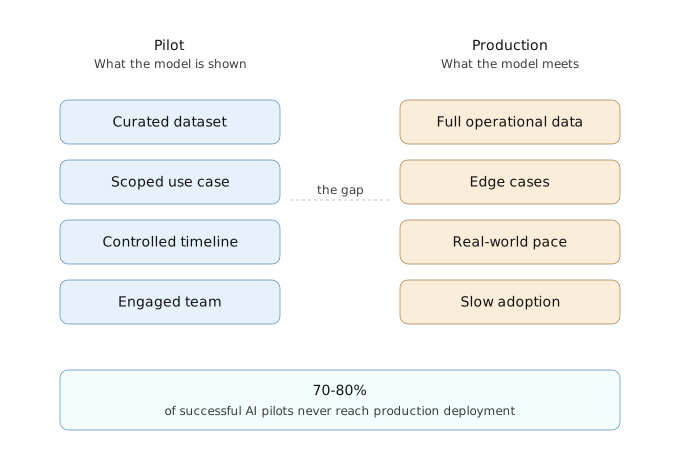
Where does manual asset tracking start to fall apart?
When your team stops being able to answer questions about your assets.
Manual asset tracking works because the people running it know the operation inside and out. The team is trained in handling the nuances of an outdated system. A driver remembers which customer has the high-pressure cylinders. The plant manager knows which kegs went out last Tuesday and which ones are overdue. The spreadsheet gets updated most of the time, and when it doesn't, someone fills in the gap from memory. Operations run this way for years, sometimes decades.
Then volume grows. Technology advances. New customers come on, routes expand, locations open, drivers leave. The spreadsheet that used to be the source of truth is questionable at best, and duplicated at worst. In one extreme case, an LPG distributor didn’t know that of the 50,000 cylinders they purchased, they only had 15,000.
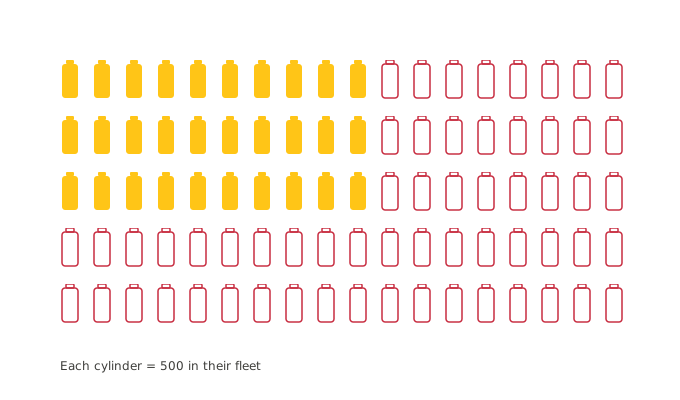
This is the inflection point. The time it takes to answer a basic question (where is asset 4471, when was it last seen, who has it now, is it usable) keeps getting longer, and the answers less reliable.
Why AI amplifies bad data instead of fixing it.
AI learns from what it's given. If the asset data is inconsistent, the AI model has no way to flag it as wrong. It assumes everything it's shown is true, and then applies flawed knowledge in its output.
Teams assume that the AI model will smooth out the rough edges in the data. It won't. A forecasting model trained on asset records where many returns are logged late and the others are logged twice will learn that this pattern is normal.
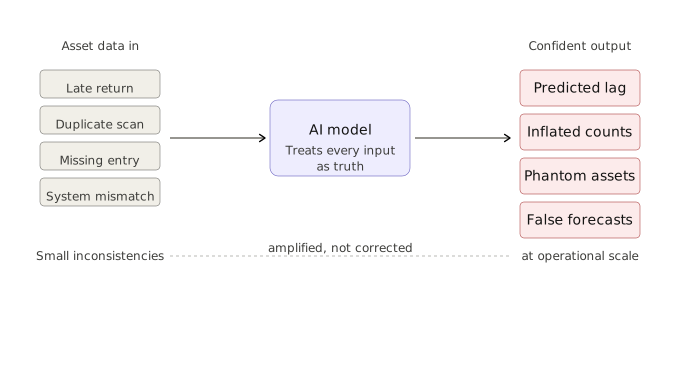 This is true across every layer of the AI stack. Training data shapes what the model considers normal. If information is fragmented, missing, or contradicted by another system, the model fills the gap with statistical guessing without telling you. An IBM survey found that nearly 49% of business leaders cite data accuracy or bias as a leading barrier to scaling AI initiatives.
The compounding problem is that AI output looks confident. A dashboard with a prediction on it reads as authoritative whether the underlying data is clean or not. By the time someone questions the number, decisions have already been made on it.
What does AI-ready asset data look like?
Asset data has to be clean, timely, and connected to the systems and people that depend on it.
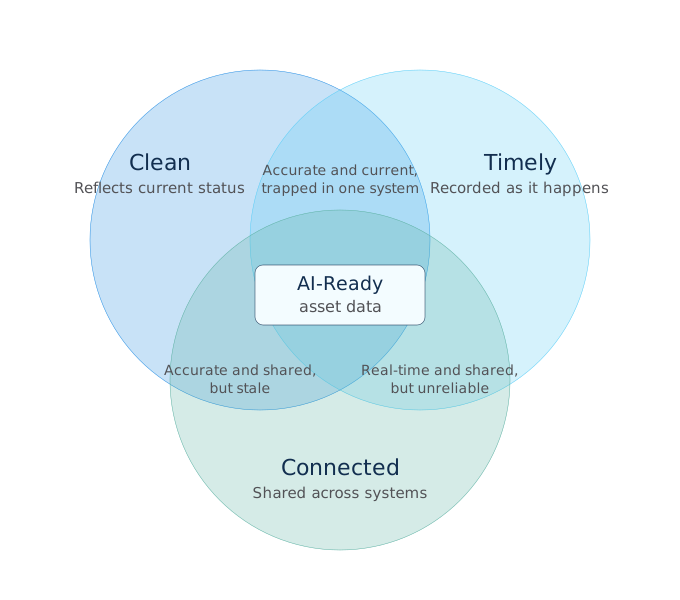
To be clean, the record reflects current status. For example, a cylinder that left the lot yesterday appears in the system as out, not as available. A keg that came back damaged is immediately logged with a description and picture.
To be timely, the gap between what happens and what gets recorded is short. A return logged a week late is a week of inventory the operation didn't know it had.
To be connected, the ERP, billing, dispatch, and other operational systems need to send and receive asset data instantly and continuously. Otherwise, asset data (and opportunities) lose value.
Good operational data is characteristic of all three in any modern operation. Left unaddressed, AI will expose the gaps faster and with more consequences.
IBM research lists these to be the most common data quality issues:
- Inaccurate data
- Duplicate data
- Inconsistent data
- Incomplete data
- Invalid data
- Outdated data
- Mislabeled data
- Biased data
- Data silos
And these to be the most common causes:
- Poor data collection
- Data entry errors
- Corrupt data transmission
- Inadequate integration
- Lack of synchronization
- Data poisoning
How to begin closing the asset data gap
The distributors getting ahead of this are treating asset data as operational infrastructure.
Consider these questions about your operations:
- How long does it take to answer a basic question about an asset?
When a customer calls asking where their cylinders are, the time it takes to give them a confident answer is a direct measure of how connected your data is. - How often do the systems disagree?
When billing pulls a count, dispatch pulls the same count, and the warehouse pulls it again, do the numbers match? - What happens to the data when core personnel leaves?
If a driver retires or a plant manager moves on, how much of their operational knowledge has passed on to their replacement?
Visibility comes first: knowing where assets are, what condition they're in, and which systems need to see that information. Then the focus moves to closing the gap between field activity and the record, often through mobile scanning, system integrations, and shared data standards across teams.
For years, IMG Nigeria, the LPG distributor mentioned earlier, struggled to keep track of assets across a combination of spreadsheets, paper records, and an in-house system that couldn't track assets once they left the facility. After implementing asset tracking software, they discovered the 35,000 gap in inventory that was suppressing revenue by as much as 25%. Once they had real-time visibility across all six facilities, the data started revealing patterns: the company could see which customer sites had the highest non-return rates, which facilities were generating the most maintenance exceptions, and where in the distribution chain cylinders were going missing. Modern asset tracking solutions are built to complement, not replace, and connect to existing ERP and logistics tools. AI implemented on this foundation has the best potential to produce desired results.
If AI is on your roadmap, the question worth asking first is whether your asset data could support it today. The webinar No Bull, No Hype: The Truth About AI in Process Manufacturing will help you evaluate your own AI readiness, and you’ll learn how business leaders like you are adopting AI in operations across process manufacturing industries.