
RQMS Capabilities
The roll quality management system built for continuous web manufacturers.


RQMS at Work
Profile & Defect Mapping
Visualize gauging profiles and discrete defects together in purpose-built rendering formats to give operators and engineers a complete spatial view of every roll.
Process Historian
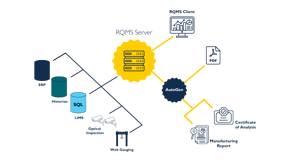
Access time-series process data directly within RQMS, no switching between systems to correlate process conditions with roll quality events.
Certificates of Analysis
Automatically generate and manage customer-facing COAs at roll completion to eliminate manual documentation entirely.
Laboratory Information Management (LIMS)
Purpose-built for roll goods manufacturing, RQMS LIMS manages lab data with the context and workflows your quality team actually needs.
Overall Equipment Effectiveness (OEE)
Automatically calculate availability, performance, and quality metrics across your production lines to track and improve operational efficiency.
Production Reporting
Product & Grade Run Centerline
Roll Labeling
Implementing RQMS at Your Site
Step 1: Discovery & Scoping
Informetric works with your team to map existing systems (gauging, inspection, historians, ERP, MES) and define integration points, product grades, and quality specifications. No two sites are identical; scoping ensures the deployment fits your process.
Step 2: System Integration
RQMS connects to your existing plant-floor systems. Native integrations with supported platforms are configured and tested. No new hardware required in most deployments.
Step 3: Configuration
Product grades, quality specifications, grading thresholds, and COA templates are configured to match your existing quality program. RQMS adapts to your standards, not the other way around.
Step 4: Commissioning & Validation
The system runs live alongside production. Operators and quality teams see their process in full resolution for the first time, including real-time roll maps, automated grading, and historical data access validated against known production runs.
Step 5: Training & Handoff
Operators, quality engineers, and IT staff are trained on the platform. RQMS is designed for daily use across multiple roles — control room operators, quality managers, and process engineers all work from the same system.
Step 6: Ongoing Support & Expansion