
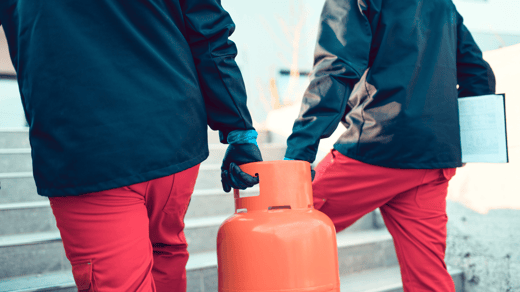
Fuel gas and liquefied petroleum gas (LPG) cylinders are more difficult to manage than ordinary inventory. These regulated, returnable assets move through filling plants and warehouses before reaching customer locations. Along the way, they may spend time on delivery vehicles or at maintenance facilities. At every handoff, you need to know where a cylinder is, who has it, and whether it is ready for service.
At best, incomplete records lead to inventory searches, manual reconciliation, and unnecessary purchases. At worst — if an overdue or blocked cylinder returns to service — the consequences can extend to safety and regulatory compliance.
Effective cylinder tracking solves these challenges by creating a dependable record for every asset. It connects each cylinder to its movements, service history, and current status, giving your operations and finance teams the information they need to manage the fleet more effectively.
In this guide, we'll cover:
- Why standard inventory tracking falls short
- How to choose the right tracking technology
- How tracking supports billing and compliance
- How to implement a cylinder tracking program
Why standard inventory tracking falls short
Traditional inventory systems are generally designed to track quantities, not individual assets. Your branch may know that it has 500 cylinders of a particular size, but that count cannot show how each cylinder arrived or where it has been. It also cannot explain whether an individual cylinder is ready for service.
That distinction matters because two cylinders of the same type can have different inspection dates, service histories, or owners. One may be ready to fill, while another needs to be blocked from service.
A serialized tracking system assigns a unique identity to every cylinder, then records events against that asset as it moves through the business. This helps operators:
- Find assets faster. Current location and custody records reduce time spent searching yards, warehouses, and customer accounts
- Reduce loss and unnecessary purchases. Better visibility helps companies recover idle cylinders before buying replacements
- Strengthen rental and demurrage billing. Serialized balances connect customer-held assets to the appropriate billing records
- Identify overdue returns. Exception reports can flag cylinders that remain with a customer beyond the expected period
- Enforce inspection holds. Business rules can help prevent cylinders that are overdue or blocked from returning to service
- Resolve customer disputes. Delivery records and asset histories provide a clearer account of each transaction
- Preserve maintenance history. Teams can review inspections, repairs, and other service events in one asset record
In many operations, the underlying problem isn't a cylinder shortage. It's a lack of reliable information about the cylinders the company already owns.
What should a cylinder tracking system record?
A practical system should follow each cylinder throughout its complete lifecycle. The process begins when an inbound asset is received and associated with a location. Employees can then inspect the cylinder and determine whether it is eligible for service.
From there, the tracking system should record the events that change the cylinder's location, status, or custodian. A typical lifecycle may include:
- Receiving and identification. Register the cylinder and confirm its unique asset identity
- Inspection and sorting. Determine whether the cylinder is eligible for filling or needs additional review
- Hold and maintenance. Record the reason for a hold, the work performed, and the final disposition
- Filling and loading. Connect the asset to its product or fill batch, then assign it to a vehicle or route
- Delivery. Transfer custody to the customer and capture proof of delivery
- Pickup and return. Record the return, update the customer balance, and place the asset back into stock
- Retirement or condemnation. Remove an asset from active service while preserving its historical record
Each transaction should update the cylinder's location and status. It should also identify the current custodian, creating a complete asset history rather than a collection of disconnected inventory counts.
Depending on your operation, the asset record may include:
- Cylinder type and specification
- Product or fill batch
- Tare and full weight
- Customer account
- Route or order number
- Requalification date
- Maintenance history
- Hold or rejection reason
- Delivery documentation
Choosing a cylinder tracking technology
There is no single tracking technology that is right for every operator. The best choice depends on your operating environment, transaction volume, and asset values. Automation requirements matter, too.
The goal isn't to adopt the most sophisticated technology available. It's to choose the least complex option that captures the required events reliably.
Barcode and QR code tracking
Barcode tracking is usually the most accessible starting point. A durable barcode or quick response (QR) code label is attached to each cylinder, and employees scan it during important events. These may include receiving and filling, followed by loading, delivery, or pickup.
Barcode systems are generally:
- Relatively inexpensive
- Easy to pilot
- Compatible with mobile devices
- Precise when used correctly
The primary limitation is that each code must usually be visible and scanned individually. Labels may also be damaged by dirt or abrasion, while repainting and chemical exposure can create additional durability problems.
Barcode is often a good fit when employees can scan consistently without slowing down production or delivery work.
Passive RFID tracking
Passive radio frequency identification (RFID) can identify assets without requiring employees to scan every cylinder individually. Readers may be placed at gates or docks, as well as near conveyors and filling areas. This makes RFID especially useful when:
- Cylinder volumes are high
- Manual scanning creates delays
- Plants use automated filling processes
- Physical inventories take too long
- Assets move through defined checkpoints
However, RFID requires more planning than barcode. Metal cylinders can interfere with radio signals, so operators need suitable tags and reliable attachment methods. Reader placement must also be tested under actual operating conditions, and equipment used in classified areas must meet applicable safety requirements.
BLE and indoor location technology
Bluetooth Low Energy (BLE) can help locate assets within yards or warehouses, providing zone-level or room-level visibility. However, it is better suited to location awareness than asset identification and does not replace the need for a serialized cylinder record.
For that reason, BLE is generally used alongside barcode or RFID rather than as a stand-alone tracking system.
GPS tracking
Global positioning system (GPS) and cellular trackers can provide off-site location data, but their cost and maintenance requirements often make them impractical for individual commodity cylinders. They may be more appropriate for larger assets, such as bulk tanks and trailers. Mobile storage units or cylinder cages may also justify the investment.
GPS is most useful when off-site location or theft recovery is the primary concern.
IoT sensors
Internet of Things (IoT) sensors can capture information about an asset or its contents, including tank level and temperature. Other devices may monitor pressure or environmental conditions.
These tools add useful condition data, but they do not provide a complete chain of custody on their own. Most operators should treat sensors as an additional layer within a broader tracking program.
Start with the process
Before choosing a technology, define the workflow it needs to support. Start by identifying where assets disappear from the record and where manual work creates errors.
Questions to investigate include:
- Are delivered cylinders assigned to the correct customer?
- Are returns recorded when they enter the plant?
- Do branch transfers create discrepancies?
- Are serial numbers captured manually?
- Are maintenance holds stored in separate systems?
- Are all customer-held cylinders being billed?
Once those gaps are understood, the company can select the least complex technology that captures the required events. Barcode may be sufficient when scan discipline is strong, while RFID becomes more attractive when manual capture is impractical. GPS and sensors should be reserved for problems that justify their added cost.
Connecting cylinder tracking with ERP and billing
Cylinder tracking delivers more value when it connects with the company's other business systems. An enterprise resource planning (ERP) system may remain responsible for customers and products, while also managing orders and invoices. The tracking platform can maintain each asset's identity and location, along with its custody and transaction history.
Depending on the operation, information may be exchanged with:
- Dispatch systems
- Rental billing systems
- Warehouse software
- Maintenance systems
- Customer portals
- Reporting tools
This integration connects physical movements with financial records. For example, a driver may deliver five cylinders and pick up three. That transaction updates the customer's on-hand balance, which can then be compared with the rental agreement or invoice.
Without that connection, a cylinder may remain in the field without appearing on the customer's bill. The opposite can happen, too: a returned cylinder may stay on an account and create a billing dispute. Linking serialized movements to customer balances helps companies identify both problems faster.
Cylinder tracking and regulatory compliance
Fuel gas and LPG cylinders are subject to safety requirements that extend throughout the asset lifecycle.
In the United States, DOT regulations establish requirements for cylinder specifications and markings. 49 CFR Part 178, Subpart C covers DOT specification cylinders, including required identification and manufacturing markings.
Requirements do not end when a cylinder enters service. 49 CFR Part 180, Subpart C addresses the continuing qualification and maintenance of cylinders. It also covers periodic requalification and the markings used to document successful requalification.
OSHA requirements also apply in the workplace. Under 29 CFR 1910.101, employers must determine that compressed-gas cylinders under their control are in a safe condition. The standard calls for visual inspection and refers employers to applicable DOT requirements for cylinder inspections.
Tracking software does not replace these regulations or qualified safety personnel. It can, however, help operators manage the information and workflows needed to support compliance.
A tracking system can:
- Store inspection and requalification dates
- Alert employees to upcoming deadlines
- Place overdue assets on hold
- Prevent blocked cylinders from being filled
- Record maintenance activity
- Preserve an audit trail
Specific requirements can vary based on the cylinder and its service. Operators should configure tracking rules around the regulations that apply to their assets and jurisdictions.
What results can cylinder tracking produce?
Datacor customer examples illustrate the potential impact of better asset visibility.
The Huber Supply cylinder tracking case study reported a 75% reduction in gas-return processing time. The company also recovered approximately $30,000 in assets during the first year of implementation.
Empresas Gasco uses TrackAbout to monitor more than 1.5 million LPG cylinders across its Colombian operations. The company has gained real-time traceability across its fleet, along with better visibility into cylinder condition and returns. It has also reduced idle time at filling plants and improved its ability to identify theft, losses, and underperforming routes.
TrackAbout has also helped Gasco strengthen its regulatory processes. The company can maintain complete audit trails and quickly provide accurate cylinder information when requested by regulatory authorities.
Other TrackAbout customers have used serialized balances to identify rental billing gaps. For example, Red Ball Oxygen reported increasing rental billing by approximately 3% to 5%. The increase followed the discovery of customer accounts with more cylinders than the billing records showed.
Results will vary by company. However, these examples show that cylinder tracking can affect more than asset location.
How TrackAbout supports fuel gas and LPG cylinder tracking
TrackAbout is a cloud-based asset tracking platform for companies that manage reusable assets. It supports cylinder-specific workflows across plant and delivery operations, helping teams connect physical movements with customer records and financial activity.
TrackAbout's capabilities include:
- Asset identification. Support for barcode and RFID helps companies select the identification method that fits their workflow.
- Plant and field workflows. Mobile tools guide employees through filling and loading. They also support delivery, pickup, and return processes.
- Maintenance and compliance. Digital records document inspections and service events, while configurable rules can help enforce regulatory requirements by flagging overdue or noncompliant assets for quarantine or removal.
- Delivery and customer balances. Proof of delivery, truck reconciliation, and serialized balances help connect cylinder movements to customer accounts.
- Integration and reporting. ERP connections and data-access tools help companies synchronize asset activity with their other business systems.
TrackAbout can also support a phased implementation. Operators may begin with barcode tracking at one location, then introduce RFID or additional automation where the business case supports it.
See how TrackAbout can help you improve cylinder visibility, strengthen compliance, and reduce asset loss. Request a demo to discuss your operation with a Datacor asset tracking expert.